
When I returned to affiliate marketing to build a new website from scratch, I assumed that speed would create momentum.
I committed to publishing one article per day and relied heavily on AI to generate content quickly because I believed that volume would accelerate traffic. Within a few months, the site had more than 70 published articles. On the surface, it looked productive and serious.
Then I checked Google Search Console more carefully.
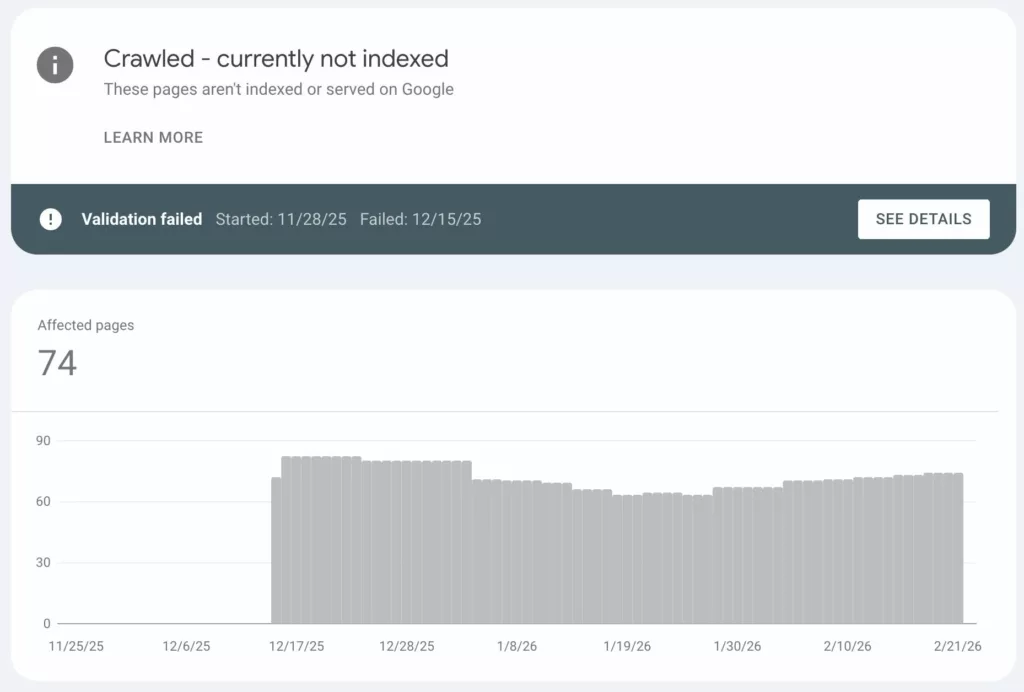
Over 70 pages were crawled but not indexed. That meant Google had discovered them, but had chosen not to include them in search results. The site was technically functioning, yet most of the content was not considered strong enough to serve. Traffic remained flat, and the gap between effort and results became hard to ignore.
This was not a technical error. It was a quality and positioning issue. The content lacked depth, clear topical clustering, and a distinct voice. Publishing quickly had created activity, but not authority.
That experience reshaped how I think about building a profitable affiliate website. Sustainable growth in affiliate marketing comes from clarity, usefulness, and focus repeated over time, not from publishing intensity.
Read more: What I Got Wrong the First Time
The Hidden Pressure Beginner Affiliate Marketers Feel
If you are starting your first affiliate website, there is often unspoken pressure behind the work.
You want proof that it works. You want to see early signs of traction so that the hours invested feel justified. When those signs do not appear quickly, doubt starts filling the silence.
In reality, the first three to six months of a new site are often quiet. Search engines need time to evaluate a new domain, understand its topical focus, and observe consistency. Early growth usually appears as gradual increases in impressions, a few keywords ranking beyond page three, and occasional clicks without conversions.
Those signals are easy to dismiss because they do not yet translate into income. Yet they indicate that indexing, trust, and relevance are forming beneath the surface.
Burnout often begins when expectations are set on immediate revenue instead of gradual authority building.
The Real Reasons Affiliate Marketing Burnout Happens
Burnout in affiliate marketing is rarely about laziness. It usually develops from misaligned effort.
Expecting fast results creates emotional instability. Many profitable affiliate sites take six to twelve months before consistent traffic appears, especially in competitive niches. During that period, growth tends to be uneven. Some articles index quickly, others take weeks, and some require updates before they gain visibility.
Publishing aggressively without a content strategy compounds the issue. Writing daily without mapping topics into clusters or aligning them with clear search intent produces scattered authority signals. Search engines struggle to understand what the site represents.
In my case, the rapid use of AI created articles that were technically correct but lacked differentiation. Without personal insight, original framing, or clear problem solving depth, the content blended into the broader internet.
Comparison adds pressure that distorts perspective. Public income reports rarely show the early months of slow indexing, low click-through rates, and ongoing content revisions. Comparing your first quarter to someone else’s third year creates unnecessary frustration.
Switching strategies too frequently prevents compounding. Changing niches, monetization models, or traffic approaches resets topical authority each time. Trust builds from repetition and consistency within a focused direction.
Read more: Why Most People Quit Affiliate Marketing Too Early
Building a Profitable Affiliate Website as a Long-Term Digital Asset
After seeing dozens of pages remain unindexed, I realised I had treated the website like a short-term project rather than a long-term digital asset.
An affiliate website functions more like a focused online publication. It requires a topical structure. For example, if your niche is beginner budgeting tools, your articles should revolve around tightly related subtopics such as budgeting methods, software comparisons, saving strategies, and common mistakes. Each article should support the others through meaningful internal links.
This structure helps search engines interpret your site as an authority within a defined subject area. Over time, clusters of related content reinforce each other, improving rankings across multiple pages rather than relying on a single article.
When you approach affiliate marketing with this asset mindset, the daily question shifts. Instead of asking how many articles you can publish this week, you begin asking whether this piece strengthens your overall authority and genuinely helps the reader.
Profitability tends to follow usefulness that is sustained and organised.
How to Set a Sustainable Content Pace Without Burning Out
I no longer aim for daily publishing. Writing one focused article at a time has proven far more effective.
AI still supports my workflow, but I now use it to outline, brainstorm, and refine rather than to replace thinking. I ensure that each article reflects real beginner concerns, practical examples, and my own interpretation of the topic. That added layer of involvement improves both quality and differentiation.
A sustainable pace depends on your real-life constraints. If you are working full-time or managing family responsibilities, one well-developed article per week is often realistic. Over a year, that results in more than 50 focused pieces of content, which is substantial when structured properly.
Early progress may appear as improved indexing rates, stronger average position in search results, and longer session durations as your content becomes more aligned with user intent. These metrics matter because they reflect strengthening trust, even before affiliate commissions become predictable.
Affiliate marketing rewards skill accumulation. Research improves. Understanding of keyword intent deepens. Content structure becomes sharper. These capabilities compound and reduce the likelihood of repeating early mistakes.
Improvement is more valuable than perfection. Publishing thoughtfully and updating strategically builds far more authority than chasing volume.
How Slow, Consistent Execution Builds Authority and Income

Authority online rarely arrives suddenly. It develops through repeated usefulness within a clearly defined niche.
When your site consistently answers related questions with depth and clarity, search engines gradually associate your domain with that subject. As authority grows, older articles begin ranking more easily because the domain itself carries more trust.
For many new affiliate websites, consistent and meaningful traffic begins to stabilise between the six and twelve-month mark, assuming content is structured well and aligned with genuine search demand. That timeline is normal and does not indicate failure.
Accepting this longer horizon changed how I approach every article. Instead of writing to force immediate proof, I now write to strengthen the foundation. That shift reduced emotional pressure and improved quality at the same time.
Building your first profitable affiliate website without burning out requires patience, realistic timelines, and a commitment to structured growth. When you remove the urgency to prove yourself quickly and focus on developing a useful, focused digital asset, the process becomes steadier. Over time, steadiness creates authority, and authority is what supports sustainable income.
