
Understanding Affiliate Marketing in Simple Terms
I understand that when you first started, you were looking for ways to earn some side income online. When most people first come across affiliate marketing, the confusion is not about the definition. It is about whether it actually works or whether it still makes sense today.
That kind of uncertainty is real. When I first started looking for ways to make money online, I came across affiliate marketing without really understanding what it meant. Most of what I saw talked about blogging and earning from a website, creating the impression that the process was straightforward. It felt like something that could start producing results quickly, especially when everything you read seems to point in that direction.
That expectation did not match reality. What I ran into instead were platforms that promised fast results, easy setup, and income in a short time. Some pushed upsells. Others simply did not deliver what they suggested. Before seeing any results, I had already spent money and time without understanding what was actually required, which is a position many beginners quietly find themselves in.
That experience changed how I look at affiliate marketing.
At its core, affiliate marketing is a way of earning money by recommending products or services created by other people. Instead of building something from scratch, you step into the space between a product and someone who needs it. When a person makes a purchase through your unique referral link, you receive a commission, typically ranging from a few percent to over 50 percent, depending on the program.
The important part is not the link itself. It is how that link fits into a real decision-making process, something that is rarely explained clearly at the beginning.
People do not buy because they see a link. They buy after trying to understand what to do next. Affiliate marketing works when your content becomes part of that understanding.
How Affiliate Marketing Actually Works Behind the Scenes
Let me explain in layman’s terms. The system behind affiliate marketing is simple in structure but precise in how it tracks outcomes, even though most of it remains invisible to beginners at the start.
A company creates a product or service and sets up an affiliate program. This program allows individuals to promote that product in exchange for a percentage of each sale. The company handles everything related to the product itself, including delivery and customer support.
When you join the program, you receive a unique tracking link. This link contains identifiers that connect any future purchase back to you.
Content is where this link becomes meaningful. You create pages that address specific questions or situations. Within that context, the link appears as a logical next step rather than an isolated promotion.
When someone clicks the link, a tracking cookie is stored in their browser. This cookie records that the visitor came through your referral. If they complete a purchase within a defined time window, which can range from 24 hours to 90 days depending on the program, the system attributes that sale to your account.
The key detail is timing. Your role happens before the purchase decision is finalized. You influence the moment when someone is still trying to understand what works and what does not, which is often where small differences in clarity make a bigger impact than expected.
Why Affiliate Marketing Appeals to Beginners and Where It Misleads
Affiliate marketing attracts beginners because it removes several layers of complexity that exist in other business models.
There is no need to create a product, which removes uncertainty around production and delivery. There is no need to manage logistics, which makes the starting point feel lighter.
However, this is where early expectations can become misleading.
From my experience, the simplicity at the surface can make it feel like results should come quickly. That belief is often reinforced by platforms that emphasize speed rather than process. When results do not appear, it creates frustration because the effort does not match what was promised, which is often where people begin questioning whether the model itself works.
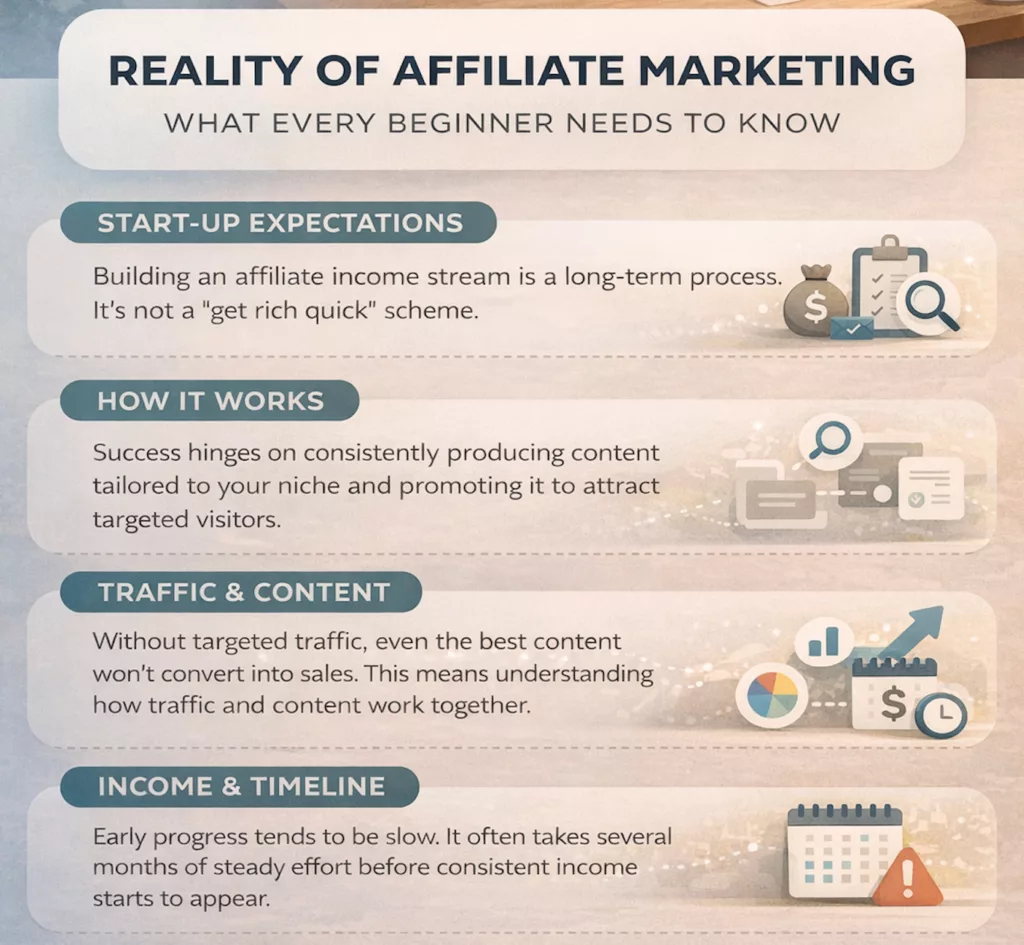
What actually replaces product complexity is the need to build clarity and trust through content. That work is less visible, but it is where the real effort sits, especially during the first three to six months when results are often minimal.
Understanding this early helped me avoid falling into that cycle of trying multiple platforms without seeing real progress.
The Role You Actually Play as a Beginner
A common mistake is seeing affiliate marketing as a process of sharing links. That view often comes from how the model is introduced.
A more accurate way to understand your role is that you are helping someone move from uncertainty to clarity, a much narrower and more specific responsibility than it first appears.
When people search online, they are trying to answer a question that affects a decision. That question may not always be obvious. Sometimes they are unsure whether something works at all. Other times, they are comparing options.
Your content becomes part of that process. It explains, clarifies, and helps narrow down choices. The recommendation exists inside that explanation.
This distinction matters because it changes how content is created. Instead of placing links into content, the content itself becomes the reason the link makes sense. You are creating value for your audience.
What You Need to Get Started the Right Way
Getting started with affiliate marketing involves a few core components, but their effectiveness depends on how they work together, which is where many beginners unknowingly create friction.
First, you’ll need a platform that gives your content a place to exist and grow over time. A website provides stability by allowing your content to be indexed and discovered repeatedly by search engines.
Then, you have to find a niche that defines direction. Without it, content becomes scattered, making it harder for readers to understand what you are about and for search engines to categorize your content.
If you choose a niche purely because it’s trending or pays high commissions, it often becomes difficult to stay consistent long enough to see meaningful results. What looks like a smart decision at the start can slowly turn into something you avoid working on.
Affiliate marketing takes time to build. Progress is gradual, and most of the work happens before any visible return. When there is no real interest in the topic, even simple content begins to feel heavy, and consistency starts to slip.
Trying to create genuinely helpful content in a space you are not engaged with rarely works in the long run. Readers can sense when something lacks depth, and over time, that disconnect affects both trust and results.
After deciding on a niche that you are passionate about. Research on Affiliate programs provides the products you recommend. When these products match your niche, your content remains consistent. When they do not, the recommendations feel disconnected.
Then comes the most important bloodline, traffic. Traffic connects your content to real people. Most beginners rely on search traffic because it reflects existing demand. This means content needs to match real questions rather than assumed interests. Without traffic, your content remains invisible, and of course, nobody is around to buy the products you recommend.
From my experience, the gap often came from treating these elements separately. When they are not aligned, effort does not translate into results. When they are aligned, even simple content begins to perform better over time, sometimes in ways that only become noticeable after consistency is established.
How Traffic and Content Work Together to Drive Results
As mentioned earlier, traffic is not something you chase. It is something you align with, even though it often feels like you need to force it at first.
People search to resolve uncertainty or address their pain points. Each search reflects a stage in that process. Some are early questions. Others are closer to a decision.
Therefore, I think content that matches these searches becomes visible because it fits what is being looked for. Instead of creating content randomly, you start with what people are already searching for and build around it.
Over time, different pages serve different purposes. Some introduce a topic. Others help compare options. A smaller number guides decisions.
This creates a natural progression. Visitors move through content based on how clear they are, not because they are being pushed, which is why forcing conversions too early often has the opposite effect. Focus on providing value, and the monetisation will happen naturally.
How the Income Side Actually Develops Over Time
Income in affiliate marketing develops through positioning rather than immediate action.
In the early stages, it is common to see no results. This is where many beginners start to doubt the process, especially if they have already experienced misleading expectations. Some quit too early.
Content needs time to be discovered and trusted. Without that, even good content remains unseen. You have to be disciplined and create content regularly, as more content is created, visibility begins to increase because search engines such as Google will start to rank your pages and even show up in the AI results section. Create a variety of content, and different pages attract different types of visitors depending on their intent.
When content aligns with decision-stage intent, conversions begin to happen. These are usually small at first, sometimes just one or two sales after weeks of effort.
The important shift is understanding that income is not tied to a single action. It builds as more content positions itself in the right places, which is why progress often feels slow until it becomes more consistent.
To my dear friend who is reading this, never give up too early; consistency will bring results eventually.
The Timeline Most Beginners Do Not Expect
One of the hardest parts of affiliate marketing is the delay between effort and visible results.
This delay can feel discouraging, especially if time or money has already been spent on approaches that did not work. It creates the sense that nothing is moving forward.
In reality, the system is working in the background. Content is being indexed, evaluated, and gradually positioned.
From my experience, this is where I almost stopped too early. The lack of immediate results makes it seem like the approach is not working, even when progress is building quietly, which is often where persistence matters more than changing strategy.
Understanding this timing changes how the process feels. Instead of expecting quick returns, the early phase becomes about building presence.
Common Beginner Mistakes That Slow Everything Down
Many beginner mistakes come from misunderstanding how results actually develop.
Again, I don’t wish to keep repeating myself like an old man, but to remind you: choosing a niche based solely on profitability often leads to shallow content. Without real understanding, it becomes difficult to explain ideas clearly or sustain consistency.
Following platforms that promise fast results is another common issue. These platforms often focus on setup rather than substance. The result is a system that looks complete but does not attract real traffic or build trust.
Adding too many affiliate links without a strong context weakens trust. When recommendations are not supported by clear explanations, they feel disconnected.
Switching strategies too quickly resets progress. Because results take time, changing direction early prevents any approach from developing. It’s never about making quick money online; it’s about creating value first.
What Makes Affiliate Marketing Work Long Term
Affiliate marketing becomes sustainable when it is built on consistency and alignment.
Content that answers real questions continues to attract attention because those questions remain relevant. When explanations are clear, they build trust over time.
Trust connects attention to action. Without it, traffic does not convert.
As you create more content, you will notice patterns become clearer. You begin to understand what works, what does not, and why certain content performs better.
This creates a feedback loop where each piece improves slightly.
Affiliate marketing grows through accumulation. Individual pieces may seem small, but together they form a structure that gives your website authority in your niche that you are passionate about. They will continue to produce results as long as your website is alive and kicking on the World Wide Web.
So my friend, Affiliate Marketing is not a fast system, but it is a stable one when built with the right expectations. If you approach it with clarity instead of urgency, it becomes much easier to stay consistent long enough to see it work.
I hope this has helped you see affiliate marketing with a bit more clarity.
If you’re wondering how I actually built my website and the platform I chose to start with, I’ve shared more in my Wealthy Affiliate review, and you can explore it via the banner below.
