
Most people don’t quit affiliate marketing because they’re lazy.
They quit because they expected the wrong kind of progress, and when reality doesn’t match what they imagined, it starts to feel pointless.
Affiliate marketing can appear simple from the outside. You set up a website, write a few posts, add some affiliate links, and wait for things to start moving. It feels reasonable to think you’ll see some early signs. A few visitors. A couple of clicks. Maybe even a small commission that proves it’s working.
But for many beginners, the early stage is almost completely quiet. You can publish ten posts and still feel like nobody even knows your site exists. No comments, no emails, no sales, no proof. That silence is what breaks people.
And the scary part is, silence doesn’t mean it’s failing.
Not because the model doesn’t work, but because the timeline is longer than most people are prepared for.
The quiet phase nobody warns you about
Affiliate marketing, especially the slow content and SEO path, has a frustrating gap between effort and reward.
If you’ve never built anything like this before, that gap feels personal.
You can publish something genuinely helpful and still see no traffic. You can improve your writing and still feel invisible. You can show up consistently and still wonder if you’re wasting your time.
That’s when people start thinking, “If this were working, wouldn’t I see something by now?”
When I first started, the most demoralising part was seeing my posts stuck on page 5 and beyond for the keywords I actually wanted to rank for. I’d search my target keyword, scroll… and scroll… and realise my article was basically buried.
Search engines don’t care how hard you worked. They care whether your site deserves to show up.
At first, progress looks boring. Your pages get indexed. You start seeing impressions in Search Console, but still no clicks. One article moves from page nine to page five, and it doesn’t feel like a win because you’re still nowhere near page one.
That early stage can easily take weeks, sometimes months, depending on your niche and how new your site is. And it’s one of the biggest reasons people quit affiliate marketing too early.
Read More: What I Got Wrong the First Time
Why motivation disappears long before results show up
A lot of people begin affiliate marketing during a burst of energy. They see someone else succeed, they hear a convincing story, or they finally decide they want something that can grow over time.
Then the repetition starts.
You sit down to write again. You publish another post. You tweak your site. You try to learn SEO. You do it all while juggling real life, and you still don’t see results.
That’s when motivation slips away.
Here’s what nobody tells you at the start. The work doesn’t get easier; you just get stronger.
Affiliate marketing forces you to keep going even when it feels boring. It doesn’t respond to excitement. It responds to what you build over time.
The people who last aren’t the ones who stay motivated. They’re the ones who learn how to keep showing up when the work feels ordinary.
Read More: Your attitude, not your aptitude, will determine your altitude
The progress signals beginners should watch instead of income
A lot of beginners get stuck here, and it usually happens without them noticing.
They measure success by income before income is even a realistic signal.
It makes sense. Affiliate marketing is sold as a way to earn money online, so income becomes the scoreboard. But early on, income is a terrible way to judge whether you’re doing well. It usually shows up later, after the foundation has had time to settle.
Early progress is quieter, but it’s still real.
It looks like your posts are getting indexed instead of sitting invisible for weeks. It looks like your first impressions are appearing in Search Console, even if nobody clicks yet. It looks like a page getting a handful of visits that aren’t you refreshing your own site. It looks like a reader is staying on your article long enough to scroll instead of bouncing immediately.
If you want something practical to hold onto, these are the signals that helped me stay sane in the early stage:
- Your pages are indexed and searchable
- You’re getting impressions for real queries
- You’re starting to see your first clicks, even if it’s only a few
- Your rankings move slowly upward over time, not overnight
For me, I had to stop staring at rankings every day because it was driving me crazy. I kept telling myself, “Don’t focus on the ranking, just focus on creating helpful articles for the audience I actually want to serve. That mindset shift is what kept me from quitting early.
It also looks like you are finally understanding what people actually search for. Not vague topics like “make money online,” but specific problems people are actively trying to solve.
None of that feels as exciting as a commission notification, but it’s the work that creates one.
Why slow growth feels like failure online
Affiliate marketing exists in a very noisy space.
Everywhere you look, someone is claiming fast results. Someone is posting screenshots. Someone is talking about huge numbers and quick wins. Even when they’re not lying, they’re still showing the highlight reel, not the quiet months that came before it.
So when your growth is slow, you assume something is wrong.
You assume your niche is bad. You assume you’re behind. You assume you missed the window. You assume you don’t have what it takes.
But slow is normal when you’re building something that has to earn its place.
Most of the time, the problem isn’t your pace. It’s the comparison. You’re watching someone else’s middle while you’re still in the beginning.
The compounding moment most people quit right before
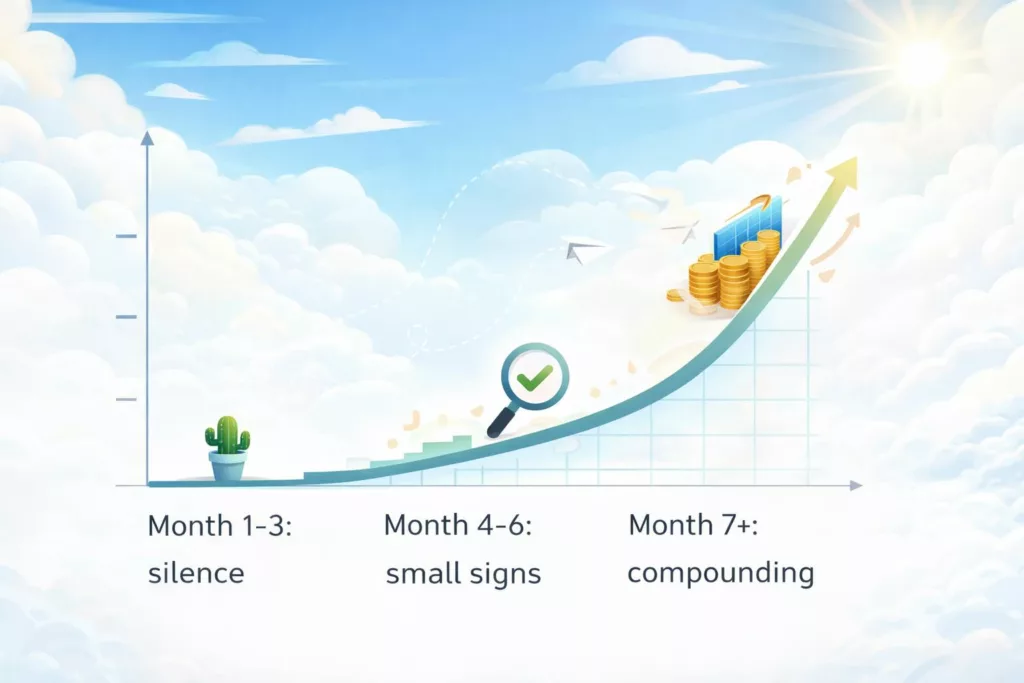
This part feels almost cruel.
In content-based affiliate marketing, the early stage is when you do the most work for the least visible reward. You write posts that barely get seen. You build pages that feel like they’re sitting there untouched. You learn lessons that don’t pay you back immediately.
In my case, the first six months felt like total nothing. No big wins. No moment where I could confidently say, okay, this is working. Just writing, publishing, and waiting.
Then one fine day, I received a notification that I made one affiliate sale.
It sounds small, but that was my eureka moment. It proved the system was real. It also proved something else. The work was never wasted; it was just early.
After that, I began to notice the small shifts more clearly. A post would climb a few pages. A random article would get clicks. Something that felt invisible suddenly had life.
That compounding effect is real, but you only get it if you stay long enough.
Why switching niches too early resets your momentum
When results don’t show up quickly, the first instinct is to change something big.
A new niche feels like a fresh start. A new website feels like a clean slate. A new strategy feels like hope. It’s easy to convince yourself that the problem is the topic, not the timeline.
Sometimes a change is needed, but most of the time it’s just panic dressed up as a smart decision.
Restarting doesn’t just change your direction. It resets the thing that takes time to build.
Your older posts don’t get a chance to mature. Your site doesn’t build topical depth. Your internal links never get to stack. You never stay consistent long enough for Google to understand what your website is even about.
You put yourself back at the beginning again, and the beginning is the hardest part to survive.
Sticking with one direction long enough to see what happens is often the real skill, not finding the perfect niche.
Read More: Identifying Your Niche: Finding What Works For You
Why does trust take longer than you expect
Affiliate marketing isn’t only about having content online.
It’s about being trusted.
This is where most beginners lose people, even if their content is “correct.”
Readers need to feel like you’re not just repeating what everyone else says. They need to feel like you understand what you’re talking about. They need to feel safe taking your recommendation, even if it’s a small one.
Trust comes from small things that add up. Clear explanations. Honest tradeoffs. A real point of view. Content that sounds like it was written by someone who has actually done the work, not someone rewriting what everyone already knows.
Search engines also need time to understand your site. They don’t treat a new website like a reliable source right away. They test it slowly. They watch whether your site stays consistent. They watch whether your pages earn engagement. They watch whether your content sticks to a real topic instead of jumping all over the place.
That’s why affiliate marketing feels slow at first. It’s not solely due to algorithms. It’s because trust takes time.
The real difference between people who quit and people who last
The biggest difference between someone who quits and someone who lasts is usually expectation.
When people believe results should come quickly, every slow week feels like a warning sign. Every quiet month feels like proof that it won’t work.
But when someone expects the early stage to be slow, they stop panicking.
They stop needing constant reassurance. They stop making emotional decisions. They focus on building a body of work that can grow over time. They give their content space to mature. They let consistency do its job.
It’s not glamorous, but it’s stable. And stability is what makes this business model realistic for normal people with real lives.
If you feel like quitting, you might just be early
If you’ve been working on affiliate marketing and it feels like nothing is happening, it’s worth pausing before you make a final decision.
Before you quit, ask yourself one honest question. Have you actually given it enough time to work?
Sometimes you’re not failing. Sometimes you’re simply in the phase where the effort is real, but the feedback hasn’t arrived yet.
That stage is uncomfortable, but it’s also where most of the foundation is built.
If you can stay calm through the quiet months, keep publishing helpful content, and stop judging yourself too early, you give yourself something most people never earn.
You give yourself time.
And in affiliate marketing, time is not just a factor. It’s an advantage.
