
People ask whether passive income is really passive more often than you might think, usually after they have already started building something and realised how much actual work is involved. The honest answer is complicated. Income that eventually behaves in a reasonably passive way does exist, but the path to it is anything but, and most of what it takes to get there is work that nobody talks about in the sales pages and tutorial videos that got you interested in the first place.
If you are trying to decide whether passive income is worth pursuing, or if you have already started and feel confused about why the work seems so much heavier than what you were promised, what follows is an honest version of the road as I have known it across more than ten years of building in affiliate marketing. There is nothing wrong with the goal itself. The problem is that the phrase “passive income” has become shorthand for something much simpler than reality, and that gap creates expectations that are quickly betrayed once the real work begins.
The Setup Phase Most People Underestimate
Every passive income stream has a setup phase, and that phase is rarely discussed with any real honesty. If you are building a niche site, the setup involves keyword research, choosing a content management system, picking a hosting provider, designing a layout, writing your first articles, learning how to format them properly, and figuring out how the entire thing connects together. None of that gets done in a weekend, even when you are working with templates. The first month tends to be all setup, and by the end of it, you have nothing to show except a website with maybe four or five articles on it that nobody is reading yet.
Digital products require even more setup because you have to build the product before you can sell anything. That means creating the content itself, writing the sales page, setting up payment processing, configuring delivery automation, and testing every step. Hence, nothing breaks when a real buyer goes through the funnel. Plenty of people quit at this stage, not because the idea was bad, but because they ran out of energy before the income could even start flowing.
For affiliate income, the setup looks different but takes a similar amount of effort. You have to choose a profitable affiliate marketing niche, research products to recommend within it, sign up for affiliate programs, get approved, learn each program’s rules, and figure out how to integrate links into your content without feeling forced or violating any platform policies. People who only see the result of someone earning affiliate commissions usually do not see the months of unpaid setup work that came first, and that gap between what is shown and what actually happened distorts the picture for everyone who comes after.
Even the research phase, before any real construction begins, can take weeks. You end up reading comparison posts, watching video reviews of tools you might use, comparing pricing tiers for software you do not yet fully understand, and trying to figure out which path will actually work for your situation. A lot of that research turns out to be useful later, but a lot of it also turns out to be wasted on options you eventually rule out. That is normal, and it is part of the hidden cost that does not usually appear in anyone’s timeline when they describe how they got started.
Learning Things That Have Nothing to Do With the Topic
One of the strangest parts of building passive income is how much time you spend learning things that have nothing to do with whatever your actual topic is. If your site is about gardening, you might assume that most of your work will involve writing about plants. In practice, you will probably spend more time learning about technical SEO, image compression, schema markup, page speed optimisation, and email service providers than you ever spend writing about plants.
This is something I did not see coming when I started in affiliate marketing more than ten years ago. Back then, there were no AI tools to speed up writing, no polished site builders, and very little feedback to tell you whether you were doing anything correctly. Most of my writing happened late at night after my day job, and I would publish without much confidence, often waiting days or weeks to see whether anything happened. A lot of my time went into learning the things that surround writing rather than into writing itself. Formatting, link structure, image sizing, page speed, and keyword placement each pulled hours from what I thought would be a writing project. The opposite of what I expected turned out to be true. Writing was the easy part once I understood the topic, and everything surrounding the writing was harder. Most of that work stays invisible to readers who only see the finished article.
Anyone building a YouTube channel ends up learning video editing, thumbnail design, audio engineering basics, and the strange psychology of how titles influence click-through rates. The work for a digital product builder skews toward copywriting, sales psychology, customer support, and refund handling. At the same time, print-on-demand sellers spend much of their time on graphic design, product photography, and the quirks of whichever marketplace they use. None of this work appears in the income reports shared online. That is part of why the path looks so much simpler than it actually is.

Maintenance Is the Quiet Tax on Everything You Build
The advice you usually see treats maintenance as a footnote, which has always struck me as a strange omission, given that the maintenance is most of the work after year one. Once a passive income stream is up and running, the upkeep is constant and easy to underestimate. Articles need updating as information goes out of date, and links tend to break in ways you do not notice until someone points them out. Plugins need updating too, sometimes urgently when a security issue appears, and there are hosting bills to pay along with the occasional migration when a provider changes something on their end.
For a content site, the maintenance load increases with site size. A site with twenty articles might only need a few hours of upkeep per month. Once you have 100 articles, that figure starts climbing because more pages naturally bring more things that can break and more outdated information that needs refreshing. The affiliate links alone can take hours to verify when you have that much content sitting on your server.
Email lists require their own kind of maintenance. People unsubscribe, deliverability changes based on engagement rates, sequences need updating when products change, and occasionally, a major email provider updates its rules in ways that force you to adjust everything to stay compliant. Gmail and Yahoo both tightened their sender authentication requirements in early 2024, and anyone running a list had to set up DKIM and DMARC properly before deliverability began to drop. If you have built your business around a platform like a marketplace or social media site, you also have to keep up with policy changes. Those changes sometimes happen with very little notice, and they can force you to redo work you thought was already finished.
The reason this maintenance work is rarely discussed is that it is not glamorous. Nobody is going to make a tutorial called “How I Spent Three Hours Updating Old Articles This Weekend.” The work happens quietly, mostly behind the scenes, and it tends to grow over time rather than shrink. Anyone who has built a few different income streams will eventually hit the maintenance ceiling, where the upkeep on existing assets takes up most of the time that used to be available for building new ones.
The Mental Load That Doesn’t Show Up in Tutorials
There is a category of work rarely mentioned in passive income content: the mental load. It is the kind of work most builders notice only once they pause long enough to feel its absence. Even when you are not actively working on your project, part of your mind is usually still occupied with it. You think about whether traffic is up or down. Your mind keeps drifting back to questions about whether you should pivot, or how the latest algorithm change might affect things, or what the next product launch should look like. There is always something turning over in the back of your head.
This kind of background processing is exhausting in a way that does not really show up until you have been doing it for a while. Working on something for two hours and then closing the laptop is one thing. Doing those same two hours and then carrying the project around in your head for the rest of the day is something else, and the trailing thoughts keep coming up at odd moments, during meals or walks or right before you try to fall asleep. The mental work is real work, even though it does not get logged anywhere or counted as time spent on the business.
In my early years of affiliate marketing, I found myself thinking about my articles at all the wrong times. I would turn a keyword idea over and over during the commute home, and find myself running through possible reasons for flat traffic while I was supposed to be cooking dinner. The laptop might have been closed, but the project was still running in the background. This happens not because you are doing something wrong, but because the work has become genuinely interesting to you, and that mental engagement is part of what allows the project to grow. The trade-off is that the line between work time and personal time blurs in a way that traditional employment does not really prepare you for.
Failed Attempts Are Part of the Real Cost
Almost everyone who has built a successful passive income stream has also built several that did not work out. The failures are usually invisible because no one writes detailed reports about projects that flop. You only ever see the wins, and that creates a misleading picture of what the path actually looks like for most people who eventually figure it out.
Most people who eventually build something that works have one or two abandoned websites, a digital product that did not sell, a YouTube channel that never grew, or some other unfinished project sitting on their hard drive. Those failures are not wasted, because each one teaches something useful about what works and what does not. They are still real costs, though, in terms of time, money, and emotional energy. Counting only the successes gives you an unrealistic sense of how efficient the journey actually is when you live through it from the inside.
My own version of this is less dramatic but just as real. When I started in affiliate marketing more than ten years ago, my first referral to Wealthy Affiliate took six months of consistent writing, which is fairly close to the realistic timeline most beginners actually face. For most of that period, I was publishing pages that never ranked and chasing ideas that sounded good but went nowhere, with no feedback loop to tell me whether I was close or miles off. Over the next few years, the referrals slowly added up to more than twenty premium members, but each one arrived on its own schedule, and none of them felt like the big breakthrough the early courses had promised. The stretch was not a single failed project so much as a long period of invisible progress, and it forced a judgment I did not feel qualified to make at the time. I am still not entirely sure whether I kept writing because I had good instincts or because I was too stubborn to stop. Probably some of both.
A different kind of failed attempt came years later, when life took priority. Work, commitments, and timing made consistency difficult, and I paused far longer than I ever planned. Most pauses begin with good intentions, and mine was no exception. I remember the exact point when I stopped writing altogether. My laptop stayed closed for weeks at a time, messages went unanswered, and I kept telling myself I just needed a break. Part of me quietly questioned whether I had lost belief in the work itself. What I eventually understood was that I had not stopped believing in affiliate marketing. I had stopped forcing progress during a period when my attention was already divided elsewhere, and the honest version of that distinction took me a while to accept.
The Work of Adapting When Platforms Change
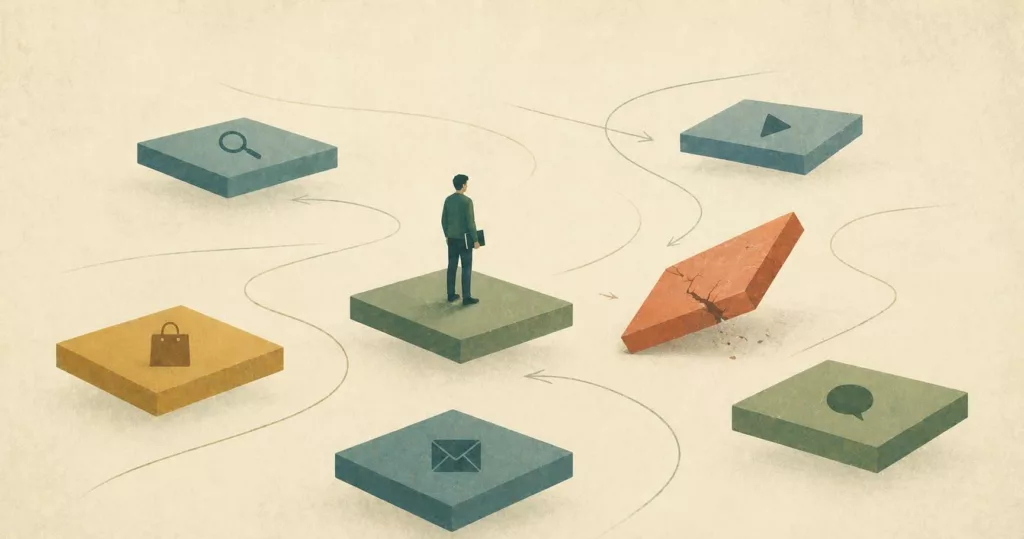
Anything built on top of a platform you do not control requires ongoing work to adapt whenever that platform changes. Search engines update their algorithms in ways that can shift your traffic overnight. The Helpful Content updates Google rolled out across 2023 and 2024 took meaningful chunks of traffic away from many smaller content sites almost without warning, and recovery for some of them stretched into a year or more. Social media sites change which content is shown to whom, and marketplaces sometimes adjust their fee structures or rules without much notice. Payment processors update their terms periodically, too, and any of these changes can require you to redo work you already finished, sometimes substantially.
This kind of adaptation work is unpredictable. That unpredictability is what makes it especially draining. You might go six months with no major platform changes, and then suddenly have to spend two weeks rebuilding part of your business because something shifted. Anyone who has been doing this for a while learns to expect these moments, but they still take time and energy that you cannot really plan for in advance. That uncertainty itself becomes part of the ongoing cost of running anything online.
Builders who stick with this over many years often end up diversifying across multiple platforms specifically to soften the impact of these changes. That diversification is itself another form of invisible work. Instead of building one thing well, you are building several related things, each with its own learning curve, maintenance load, and platform-specific quirks. Diversification helps with stability, but it does not reduce the total amount of work involved. If anything, it usually increases it, at least in the short term, while you are setting up the second and third channels.
There is also the question of what happens when something you depend on disappears. Plugins get abandoned by their developers, affiliate programs occasionally shut down or change their commission structure without much warning, and software tools sometimes raise their prices or quietly discontinue features you were relying on. None of these things is preventable, and all of them require you to respond when they happen. The ongoing work of running a passive income stream includes the slow drip of these small crises, any one of which can take a weekend to resolve, even when it looks routine at first glance.
What Honest Numbers Look Like
If you actually sit down and add up all the categories of invisible work, the picture stops looking anything like the income reports you see online. Imagine a site earning something like $500 a month. That sounds great until you factor in roughly 15 hours a month of maintenance, the mental energy spent thinking about it, and perhaps 200 hours of unpaid setup work that came before any income arrived. The exact numbers vary widely from person to person, but the shape is the same. The income is real, but the path to it usually involves more hours than most people realise when they start.
This is not a reason to avoid building passive income. The math can still work out well if you stick with something long enough, and the income tends to compound in ways that traditional work does not. The point is that the early returns are often misleading, and the long-term returns require ongoing investment that gets glossed over in most of the content you find on the topic. Once you understand the true shape of the work, you can plan your time and energy accordingly rather than being surprised by it later.
A more honest framing is that most passive income is heavily weighted toward upfront work, with smaller maintenance tasks spread across the years that follow. That is a less exciting description than “earn money while you sleep,” but it is closer to what the experience actually feels like once you are in it. The exciting framing sells courses well, but the honest framing tends to produce people who actually stick with the work long enough to see results.
What Changes When You Stop Calling It Passive
There is a fair argument that calling all of this “work” instead of “passive income” makes the whole project sound less appealing than it actually is. Maybe so, but something interesting happens when you start being honest with yourself about how much work passive income actually involves. The pressure to find the perfect “set it and forget it” system tends to ease up because you stop expecting it to exist. You start choosing projects based on whether you would enjoy the ongoing work, not just whether the income looks attractive on paper. That shift in criteria changes which projects you start in the first place, and it usually leads to better long-term outcomes.
This shift in framing makes a real difference in how sustainable the work feels. People who build passive income streams expecting them to require minimal effort tend to burn out quickly, because the actual workload feels like a betrayal of what they were promised. Those who go in expecting it to be more like running a small business that happens to have some passive elements tend to last much longer, because their expectations match the reality of what the work actually involves day to day.
After more than ten years in affiliate marketing, I have come to notice that almost nobody who has stuck with this work for long describes it as passive. They describe it as flexible, leveraged, or interesting, but rarely passive. The word is more useful as a marketing term than as an accurate description of what the work involves day-to-day. That is not necessarily a bad thing, but it does help to know what you are actually signing up for before you commit a year of your life to it.
The invisible work behind passive income is not a hidden flaw in the model. It is just the part of the equation that does not fit neatly into a sales page or a YouTube thumbnail. Once you can see it clearly, you can plan for it more honestly. You can also make better choices about which kinds of work you are actually willing to take on for the long haul. That decision usually matters more for your long-term outcomes than picking the right niche or following the right strategy.
