
When you are new to affiliate marketing, one of the first things you run into is the question of how you actually get paid. You sign up for a program, receive your links, and then realize the harder part is sending people to those links in the first place. Traffic is the challenge most beginners do not fully anticipate, and the affiliate model you choose has a direct effect on how difficult that challenge becomes.
CPA and CPS are the two models you will encounter most often. For beginners in particular, understanding the difference between them is not just an academic exercise. Choosing the wrong model early on can cost you time and money before you have had a real chance to learn anything useful.
What Is CPA in Affiliate Marketing
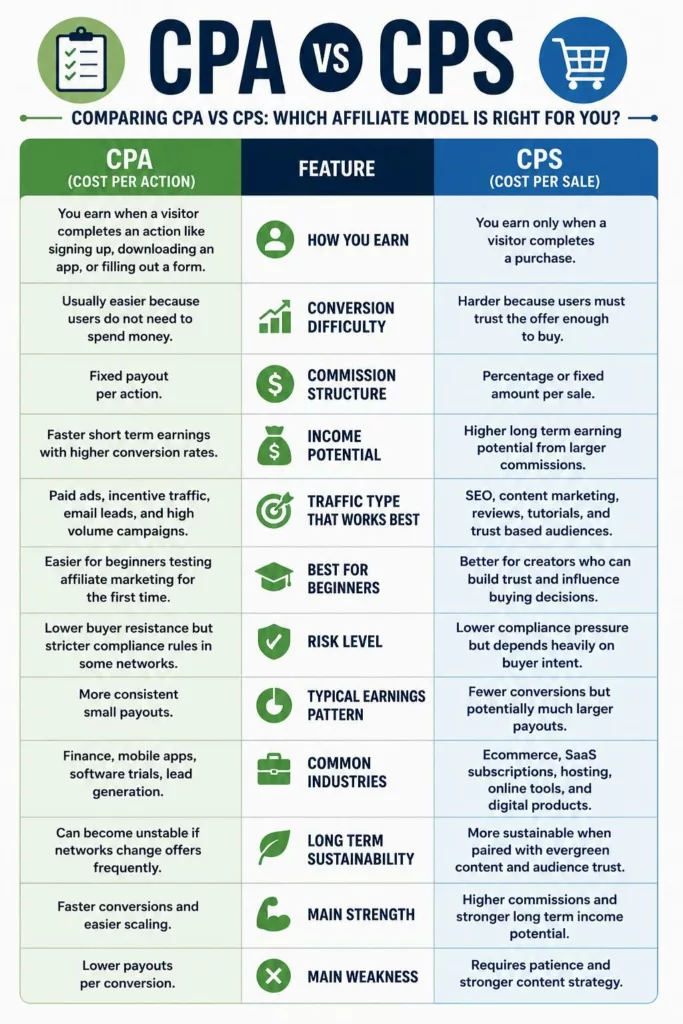
CPA stands for Cost Per Action. When you promote a CPA offer, you earn a commission when someone you refer completes a specific action, and that action does not have to be a purchase. Depending on the offer, the required action might be filling out a form, signing up for a free trial, or submitting an email address.
Because the barrier to conversion is lower, CPA offers tend to produce results more easily than sale-based ones. Someone clicking through and entering their email requires less commitment than pulling out a credit card. This is part of why CPA feels appealing at first, especially when you are not yet confident in your ability to attract buyers.
The payouts per action are usually smaller, sometimes just a few dollars for a simple form submission. Because the model runs on volume, you need a consistent flow of traffic to make the earnings add up.
What Is CPS in Affiliate Marketing
CPS stands for Cost Per Sale. You earn a commission only when the person you refer makes a purchase. The commission is either a fixed amount or a percentage of the sale price, depending on the program’s terms.
This is the model most content-based affiliate marketers use. Amazon Associates is one of the most common starting points for beginners following this path, and most e-commerce platforms and digital product marketplaces pay on the same per-sale basis. Commissions are generally higher than CPA payouts because the transaction carries more value for the merchant, and merchants tend to share more of that with you.
Getting someone to buy something is a fundamentally different request than asking them to sign up for a free trial. A purchase involves doubt, comparison, and the question of whether the person recommending the product has actually used it. That is why CPS tends to work best when the content is built around a real product experience rather than a summary of features lifted from a sales page.
Most beginners choose their first affiliate program based on commission rate alone, which turns out to be the wrong starting filter for reasons the program description rarely mentions.
How CPA Works for Beginners
CPA looks like the obvious choice for beginners, and the reasoning behind that impression is not entirely wrong. If an offer converts, you can see results more quickly than with a sale-based model, and the lower barrier to conversion makes it easier to confirm early on that your traffic is actually working.
The practical difficulty is that most reputable CPA networks are not easy to join as a beginner. Many require an application process, a phone interview, or evidence of existing traffic before they will approve you. Once inside, compliance standards are strict. Sending low-quality traffic, even accidentally, can lead to reversed commissions or a suspended account.
The payouts are smaller per action, so without meaningful volume, the earnings remain modest. Free traffic tends to build slowly, and the volume most beginners can realistically generate in their first six to twelve months is often not enough to make CPA worth the effort.
How CPS Works for Beginners
For beginners without an advertising budget, CPS is the model that actually suits how organic traffic builds.
A product review you write today might earn commissions for years if it ranks in search results and stays relevant to what people are looking for. That compounding effect is difficult to replicate with CPA, where offers change frequently and campaigns rarely produce lasting results. Most affiliate content sites take between six months and a year before organic visits become meaningful enough to support regular earnings.
The upfront cost is genuinely low. WordPress is free, and content costs nothing but the time it takes to produce. What is harder to prepare for is the pace of early growth. Publishing articles regularly for months and earning nothing from them is genuinely discouraging. Most people stop during that period, not because the model is broken, but because nobody tells you upfront how quiet the early months actually are.
Which Model Suits Beginners with a Limited Budget
The clearest way to choose between CPA and CPS is to be honest about what you are actually starting with, not what you hope to have in a few months.
If you are starting with no existing traffic, no advertising budget, and no experience running paid campaigns, CPS is the model that fits your situation. The reason comes down to how each model converts. CPA depends on volume, and volume requires either paid traffic or an audience you have already built. Without one of those in place, the per-action payouts are too small to generate meaningful income from the traffic levels a new site typically sees.
CPS converts differently. A single well-written review targeting a specific product search term can earn a commission from a handful of readers, because those readers arrived with buying intent already formed. The volume required is lower than most people assume, which means organic search is a realistic traffic source for CPS even when you are starting from zero.
The practical test is straightforward: if you cannot afford to lose the money you are considering spending on ads, CPA campaigns are not the right starting point. Paid affiliate traffic has a real learning curve, and the costs come out of your ad budget before they come out of your results.
Most of the advice beginners find online skips this part, which is probably why so many people burn through their first ad budget before understanding what it was supposed to teach them.
The Cheapest Platforms to Start With
For beginners, a self-hosted WordPress blog is the most practical starting point. A basic hosting plan runs between five and ten dollars a month, and a free WordPress theme is sufficient to get started without worrying about design costs. From there, the traffic strategy is organic search.
Pinterest is worth considering for visually oriented niches. It functions more like a search engine than a social platform, meaning content you publish there can continue driving visitors long after you have posted it, without any ad spend. YouTube is another option that requires no upfront cost, and a channel built around product reviews or tutorials can build an audience that buys from your recommendations as it grows.
The interesting thing about starting without an ad budget is that it forces you to learn something paid traffic often skips: whether your content actually resonates with anyone before you spend money amplifying it.
If you do eventually have a small amount to test with, a boosted post on Facebook costs as little as five dollars and shows you whether a piece of content generates any interest before you commit to a full campaign. The goal at that stage is not to drive conversions but to find out which content your audience responds to, so the money you spend later is based on something real rather than a guess.
Beware of Scammers Targeting Beginners
Something that does not get discussed enough in beginner affiliate marketing is the risk of fraud, specifically the kind that targets your advertising accounts rather than your links.
As you start exploring affiliate programs and networks, you will encounter people offering to run ad campaigns on your behalf, claiming they have proven methods to drive traffic faster than you could manage alone. Some of these offers come from legitimate service providers, but a significant number do not.
One pattern to watch for involves someone requesting access to your advertising account, whether that is your Facebook Ads Manager, Google Ads account, or any other platform where your payment information is stored. Once they have access, they run campaigns that benefit them while the ad spend charges against your account. By the time you notice, they are gone, and you are left with an account suspended for irregular activity and a bill you did not authorize.
Never grant a third party access to your advertising account without verifying their identity, establishing a written agreement, and understanding exactly what they are permitted to do. If someone is promising guaranteed traffic results or unusually fast returns, that is a reason to walk away rather than engage. Real affiliate growth, particularly at the beginner stage, is gradual and does not come with guarantees.
Stick to affiliate programs and networks with established reputations. Recognized platforms have accountability built in for when things go wrong, and that protection is something individual operators simply cannot offer.
Where to Start
For a beginner comparing CPA and CPS, the clearer path is usually CPS through content. It costs less to start, aligns naturally with free traffic strategies, and builds something that grows steadily rather than something that depends on constant campaign management.
I started with Wealthy Affiliate, which runs a training bootcamp that teaches beginners to write reviews of other platforms and rate them as legitimate or not. The approach gave me a clear content direction and a reason to start publishing. At the time, that felt like enough.
What I did not realize was that every other beginner following the same bootcamp was writing almost identical reviews, all pointing toward the same conclusion. The make money online niche was saturated not just with competition generally but with Wealthy Affiliate affiliates specifically, each following the same training and producing the same kind of content. My articles were not competing with established authority sites but with hundreds of people who had started from exactly the same place I had.
The lesson I took from it was to look at what other people are already publishing in a niche before committing to it, even if you feel confident about the topic. Passion for a subject matter, but it does not guarantee that the audience can find you or that your content will stand out from what already exists.
The content you create should genuinely help the reader make a decision, because that kind of writing tends to earn trust, and trust is what converts in this model.
I paused for a while before coming back to this. The make money online space taught me a lot about how affiliate content works, and I am still working out what niche I actually want to build around long-term. Starting over in a different niche is not a failure of the model. It is closer to figuring out what the model is actually for. I am not sure I have fully answered that yet.
The income will be slow at first. That is not a sign that something is wrong. It reflects how long it takes to build an audience from nothing, and the people who stick with it past that early quiet period are the ones who eventually see it work.

This breakdown of CPA vs. CPS is incredibly helpful, especially for affiliate marketers who are trying to figure out the best way to monetize their traffic. As someone exploring both content marketing and paid strategies, I appreciate how clearly the pros and cons of each model are explained.
I found the hybrid funnel idea (starting with CPA to build a list, then using CPS offers) particularly insightful. It feels like a smart way to balance short-term income with long-term growth, especially if you’re nurturing an audience that needs time to build trust before making a purchase.
Thanks for including specific examples like Swagbucks and Wealthy Affiliate—it makes the strategies feel much more actionable. Definitely bookmarking this for future reference. Also curious—have you found one model to perform better than the other in 2025, or is it still really audience- and niche-dependent?
Thanks so much for your thoughtful comment—I’m really glad the breakdown helped clarify things! You’re absolutely right, choosing between CPA and CPS (or combining both) can really depend on your strategy, audience, and where you are in your affiliate journey.
I love that the hybrid funnel approach stood out to you—it’s one of my favourite ways to create a balance between quicker wins and building long-term trust. Starting with CPA offers to build your list and then nurturing that list with value-driven CPS promotions is a great way to keep things sustainable.
As for which model performs better in 2025, honestly, it’s still very niche and audience-dependent. For example, CPA tends to do really well in niches with fast, low-commitment actions (like finance or survey offers), while CPS shines in value-rich niches like software, education, or blogging, especially when the product requires more explanation and trust-building.
So glad you’re diving into both content and paid strategies! That combo gives you so much flexibility to test and scale. Appreciate the bookmark—and feel free to reach out anytime if you want to bounce ideas or talk funnels!